I Know What Happened to Christopher Marlowe
Part II: Handwriting Comparison
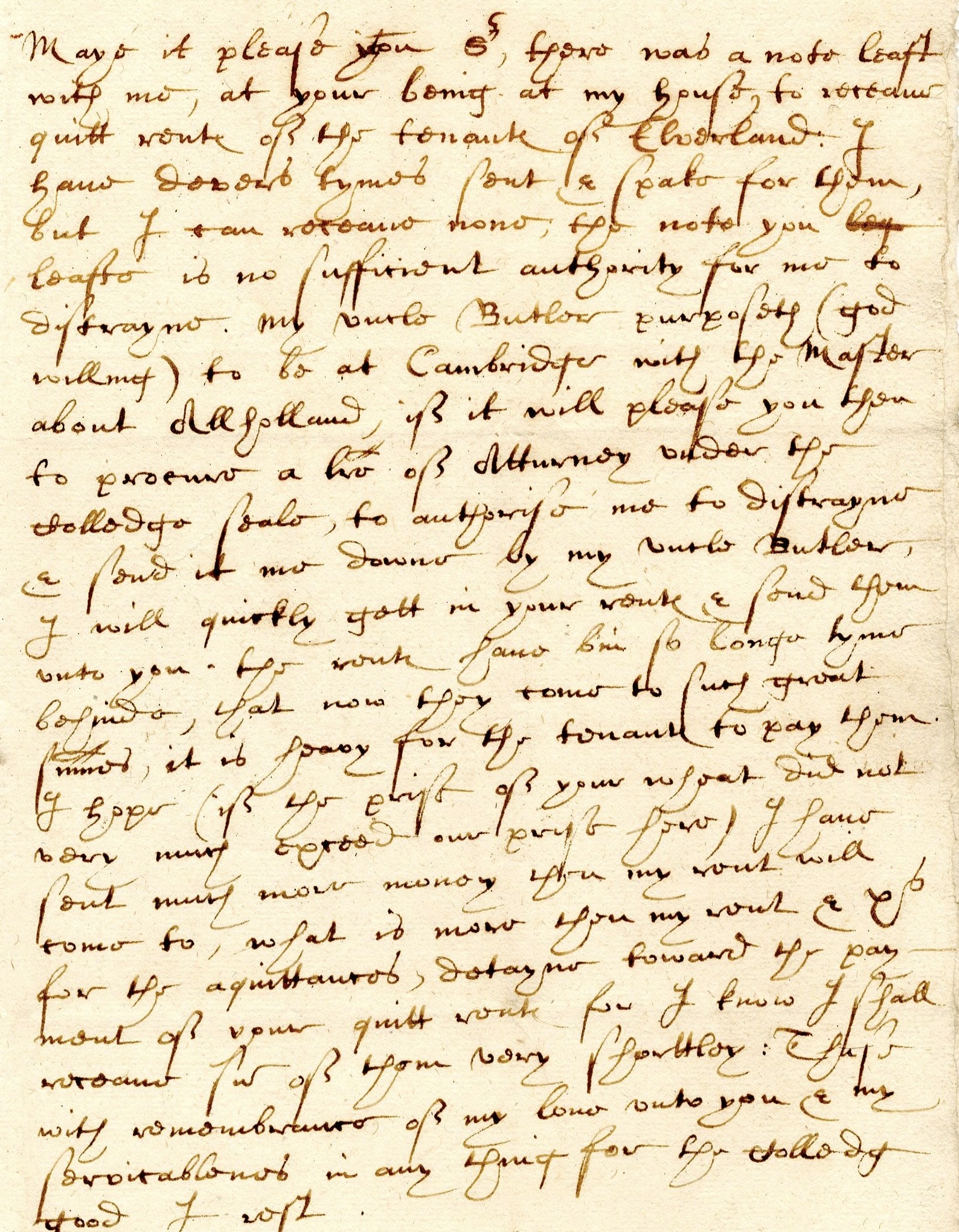
From around 1608 to 1624, Edward Master wrote several letters from Ospringe to his “very good friend” Owen Gwyn — bursar and later master of St John’s College, Cambridge. These letters are preserved in the college archives, and provide a useful handwriting sample for the later Master.
Gwyn’s name appears, granting publication, on the 1605 Stationer’s Register entry for The Return from Parnassus: Or the Scourge of Simony. This work and its two prequels are known collectively as the Parnassus Plays. The dramas in this trilogy were performed by and for students as part of the college’s annual Christmas festivities, between 1598 and 1602. They are an important source of information regarding contemporary reception of Shakespeare’s work, and also contain remarks about, and characterisations of, several other literary figures of the period. Gwyn was well placed to have had some connection to their subject matter: besides being a fellow of St John’s during the period in which they were staged, as well as the signatory for their publication, he had been a student at the college at the same time as Marlowe’s friend the writer Thomas Nashe, and Henry Wriothesley the Earl of Southampton — a patron of both Shakespeare and Nashe. Nashe and Wriothesley are thought to be depicted in these plays, as the characters Ingenioso and Gullo. Concurrently during the 1580s, Marlowe studied at nearby Corpus Christi. It is likely that Marlowe and Nashe first met at Cambridge. Thus it is plausible that Gwyn was an old college friend of Christopher Marlowe.
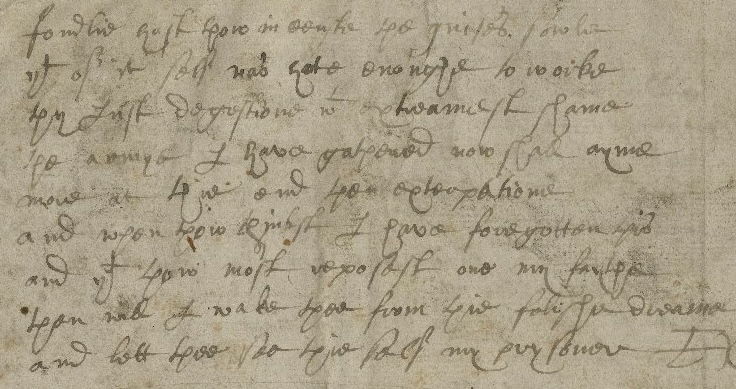
For comparison with the younger Marlowe’s handwriting, we shall use the so called “Collier leaf” — a fragment from Marlowe’s play The Massacre at Paris. This is accepted by e.g. the current Oxford Dictionary of National Biography entry for Marlowe, to be in Marlowe’s hand.
From a visual inspection of the letterforms and word clusters of these sources, they do appear to be in the same hand, though writing in two different “modes” — hurried fair copy (the Collier leaf) and formal letter-writing (Master’s letters to Gwyn). Click here for a side-by-side comparison of the handwriting in these documents. I used a current AI tool — Google Gemini 3.5 Flash (in Google AI Studio) — to make paleographic comparisons of the documents. It has been noted that Google Gemini’s latest versions (3+) have made a distinct leap in their ability to transcribe and recognise historical handwriting, and they (as well as other AI platforms) have increasingly been used in recent studies.
The result is that Google Gemini positively identifies Master’s handwriting to be written by the same person as the Collier leaf of Marlowe’s writing, the majority of the time. In repeated runs, Gemini maintains this positive identification 97% of the time (97 out of 100 runs).
The prompt used was as follows:
Act as a forensic document examiner. Please compare the handwriting in the attached images. Note, the first image was written around twenty years before the second. Same hand? Please ignore historical provenance
Note, similar results are obtained by simply using the prompt, “Same hand?”.
The prompt is accompanied by two uploaded images: the verso (back side) of the Collier leaf, and one of Edward Master’s letters — both trimmed to remove marginal stage directions (written in italic, as opposed to secretary hand), and Master’s signature.
Here are some statements from various Google Gemini responses:
Based on a forensic examination of the handwriting in the two provided images, there is strong evidence to indicate that both documents were written by the same hand.
Based on the high degree of similarity in idiosyncratic letter formations, ligature habits, spacing, and structural execution, the evidence strongly points to both documents being written by the same hand.
The structural execution, the angle of the writing slope, and the highly specific ductus of key letters (particularly 'w', 'I', and the 'th' ligature) indicate a shared scribal identity. The evidence strongly supports the conclusion that both documents were written by the same hand.
Overall, it is clear that Google Gemini strongly identifies the handwriting in the Collier leaf as the same as Edward Master’s handwriting.